I have recently had to study some models that use fractional derivatives, which I knew nothing of before. Turns out, these are a lot of fun, and deserve their own post. The notion was apparently already formulated by Leibniz, but there were difficulties involved that kept it from being widely used (such as being, well, bloody difficult). We’re mostly going to ignore those and dive in as if this is a normal thing for a human to do. I want to thank the excellent video at https://www.youtube.com/watch?v=A4sTAKN6yFA for introducing the topic to me this way.
The basis of the idea is simply that the derivative of the integral is the function itself, or

(I’m simplifying here, so just assume that the function has all the nice properties to make this possible). Of course, we will need this to hold for higher orders as well. If we denote by 


Fortunately, iterated integrals are not a problem, thanks to the Cauchy integral formula (the other one):

Remembering that 


There’s a bit of a problem. here regarding integrability. For instance, if you take 

We lost uniqueness here, since now we also have to specify the constant 

If you look at this informally, you’ll see the derivatives and integrals “cancel out”, except for the integral of order 

This particular approach is called the Riemann-Louisville derivative, and it’s not the only one. In fact, there are several definitions of the partial derivative using different kernels – and they’re not equivalent. For the moment though, I think this one illustrates the point well enough, so let’s suspend looking at the others. To see how this would work, let’s compute the 


According to our definition, we now need to find


To check our integral, we do it numerically in Python with the script
import numpy as np
import matplotlib.pyplot as plt
import scipy.integrate as integrate

def fun1(t,a,x):
    return (1/np.sqrt(np.pi))*(t**2)/np.sqrt(x-t)

def int0(a,x):
    return integrate.quad(fun1,a,x,args = (a,x))[0]

def check(t):
    return (1/np.sqrt(np.pi))*16*(t**2.5)/15

xspace = np.linspace(1/100,1,1001)# - (5-1)/100,101)

valspace = []
for j in xspace:
    valspace.append(int0(0,j))

valspace0 = check(xspace)

plt.plot(xspace,valspace0, label = 'Int')
plt.plot(xspace,valspace, label = "Num")
plt.legend();
This gives us the following figure, where only one function can be seen, because the two fit snugly on top of each other.

Now that we have some confidence that we’ve evaluated the integral correctly, all we need to do is take the derivative twice to get to the desired 3/2 fractional derivative:

Still, does this make sense? There are certainly some intuitive rules that should be followed by our fractional derivative, namely that it should be somehow sandwiched between the integer derivatives, and that there should be a continuity here: we would expect the 0.75th derivative to be closer to the first derivative than the 0.5th one, for instance. Since I don’t want to do an extra bunch of integrals, let’s numerically differentiate some integrals like the above and see if we get closer to the first derivative. But since this post is getting out of hand, let’s leave that for the next one…

 , and suppose the original dice has probability function
  . What if the probabilities are not equal (the die is weighted)?
 and
and  . We can try to make this work by analogy (which is how most mathematics is done). Suppose we have functions
 are random variables over the reals with reader’s choice of appropriate
  -algebra.) We set

 and
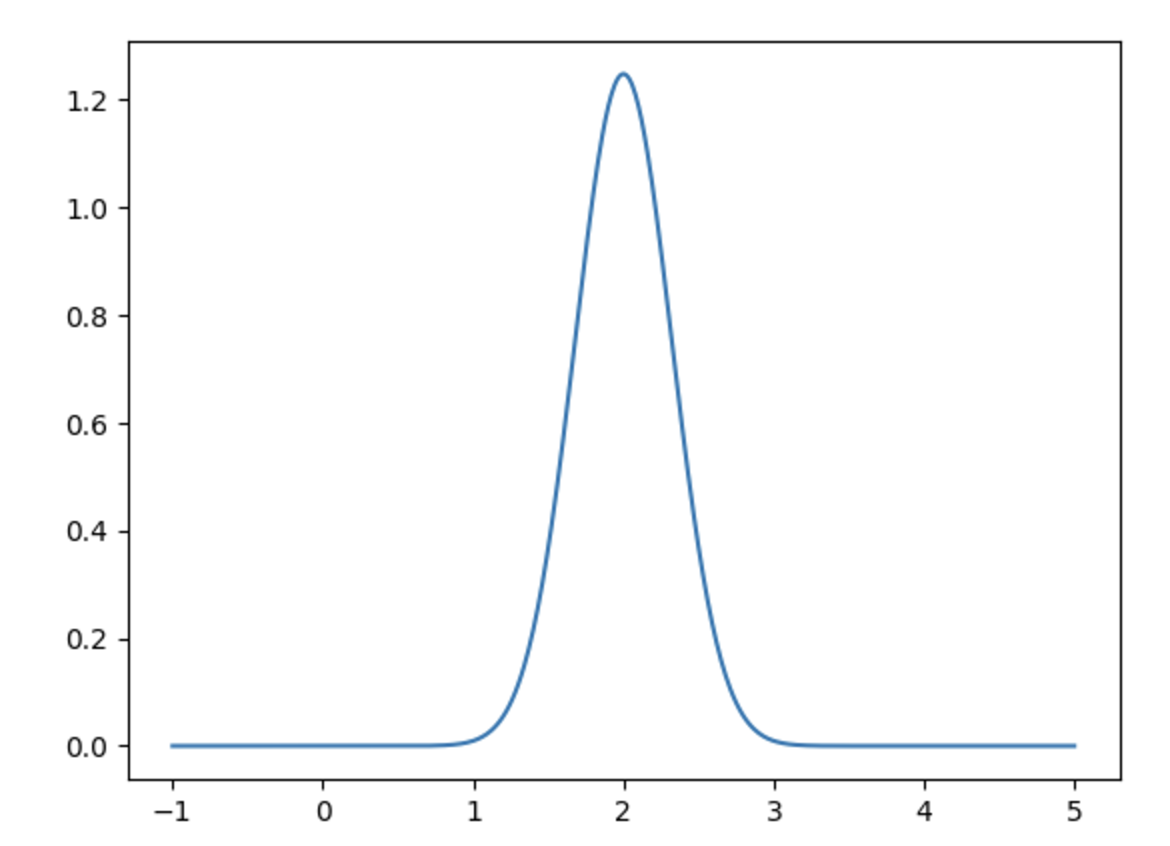
and  , we get the following graphs for the density functions:



 Trying to be a mathematician